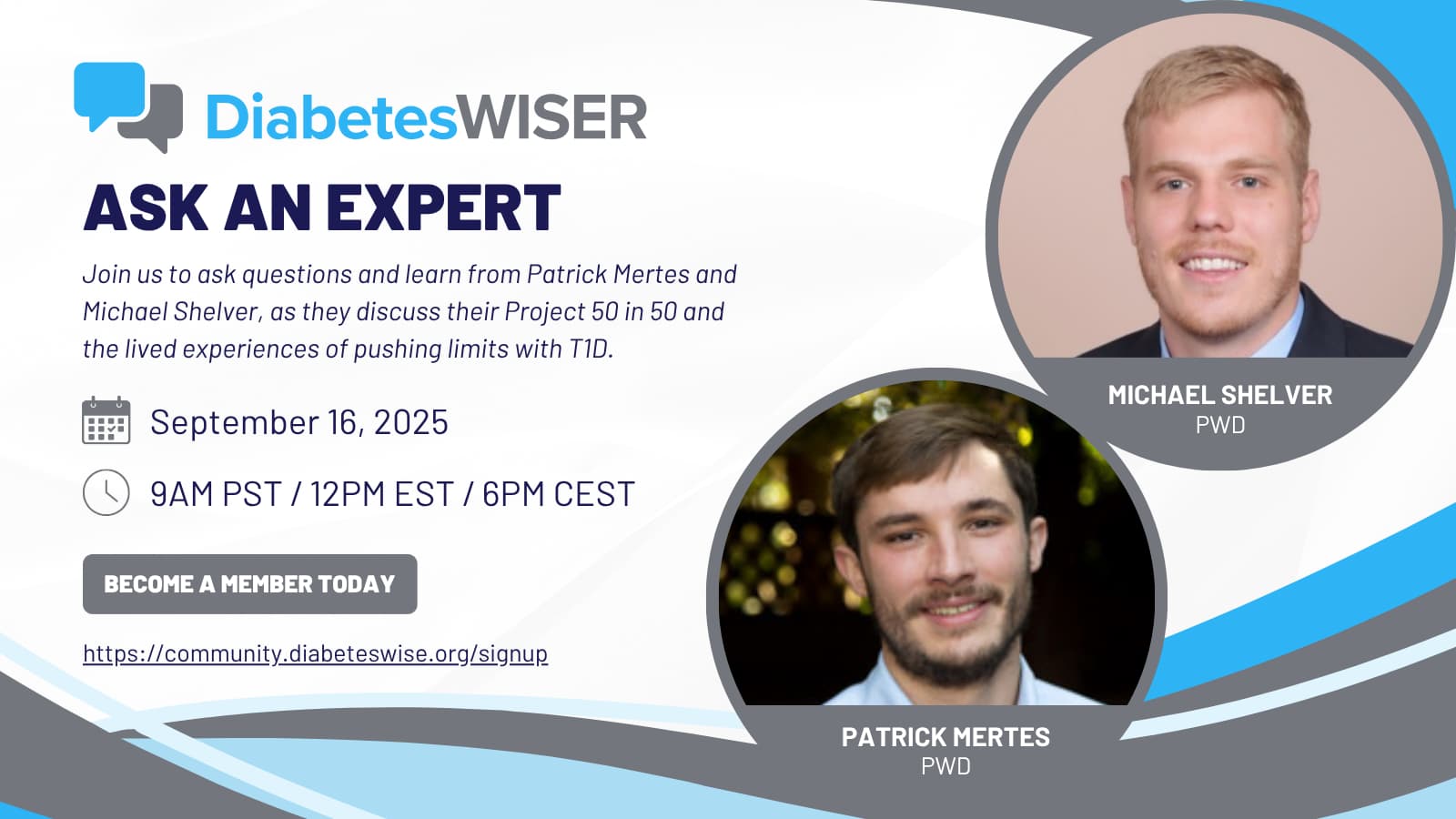
Join Patrick Mertes and Michael Shelver to answer all your questions regarding Project 50-In-50! They’re here to share their personal stories of dealing with the challenges and obstacles of T1D. They’re also here to give tips on outdoor activities, handling altitude, packing essentials, and keeping insulin safe, among other things!
They will be answering questions live for 1-hour on September 16, 2025 at 9AM PT / 12PM ET / 6PM CEST. But feel free to ask questions ahead of time!
Project 50 in 50 is impressive! This is the first time I heard about it & really enjoyed exploring your website & reading about your adventures. Although I was concerned you weren’t carrying oxygen for your Florida summit.
I have two questions:
How do you find altitude/ cold impacts blood glucose levels?
What are you carrying your insulin etc. in & did it hold up to the full 50 days? It would be great to know what “adventure proof” containers there are that we can trust our insulin to for multi-day trips.
I completely agree with Tama! Project 50 in 50 is impressive!
Building on Tama’s altitude question: I’m curious about managing altitude alerts on insulin pumps during high-elevation activities. How do you handle those alerts in real time (if you get them) without letting them disrupt your diabetes management? Are there any tricks or pump settings you use to balance safety with minimizing alert fatigue at altitude?
Hi y’all! I’m Patrick Mertes. I’ve been living with T1D for nearly 28 years. Over the last 6.5 years, my close friend and fellow T1D adventurer, Michael Shelver, and I have taken on a number of high-adventure expeditions with the goal of inspiring other folks living with diabetes to dream big!
Some of our favorite expeditions include:
•Project 50-in-50: summiting the highest natural peak in all 50 U.S. states — which we completed in just 49 days.
•Race Along the Trace: a 3.5-day, self-supported bikepacking journey covering all 444 miles of the Natchez Trace Parkway (Nashville, TN → Natchez, MS).
•Rim-to-Rim-to-Rim (R2R2R): running the Grand Canyon South Rim → North Rim → back again (~44 miles, 11,400 ft of climbing) — which we finished in under 17 hours.
•Project Low to High: starting at Badwater Basin (the lowest point in the U.S., 282 ft below sea level), biking 135 miles through Death Valley, and then summiting Mt. Whitney (the highest point in the lower 48 at 14,505 ft) — all within 37 hours.
•Our Instagram @project50in50 highlights a lot of these adventures
We’re so excited and honored to be here with you today, and we’re looking forward to your questions!
Thanks for the kind words, Tama. Florida was indeed a rough one!! Great questions! I’ll tackle the first:
How do you find altitude/ cold impacts blood glucose levels?
I wish I had a simple answer, but honestly there are so many variables at play on these expeditions (adrenaline, extreme exertion, lack of sleep, dehydration) that it’s tough to tease out the sole effects of altitude or cold.
Our research suggests that both can put stress on the body and may initially raise our glucose levels. In practice, though, our numbers are often all over the map! That’s where technology has been a game-changer. We’re both very thankful for CGMs, so we can make adjustments on the fly and keep moving forward.
Great question, Selma! Safety is always our number one priority, especially around hypoglycemia. At the start of an expedition, we typically set very conservative pump settings (usually a significant reduction in insulin) and then adjust gradually as the trip progresses, since most of our challenges are multi-day or long-duration efforts.
The big advantage of traveling with another person with T1D is that we both “get it” (all of the additional challenges that come with T1D). We build in breaks when needed, treat highs and lows as they come, and never let the excitement of the adventure outweigh the importance of our safety.
We’re also very aware that most diabetes technology hasn’t been formally tested in these kinds of extreme conditions. Because of that, we always carry backups (glucometers, glucagon, syringes, pens) so if a device malfunctions, we’re still covered. Fortunately, we haven’t had a major failure yet, but having redundancies gives us peace of mind.
And while we both feel the very real fatigue of alerts and alarms from time to time, if there’s ever a circumstance when we truly value them, it’s during these extreme challenges. They’re not just notifications - they’re lifelines!
ALL THE CARBS! Haha! I love it. I get the most bang for my buck (and pack weight) using Clif Bloks - energy chews. From a taste standpoint - Peanut M&Ms!
Hi @PatrickM and @mountainmike! You are both awesome and I hope we get a chance to meet in person one day
Did either of you have any injuries along the Project 50 in 50 journey? Do you have any quick stories about a difficult day and how you overcame it? You’re both so inspiring!
It’s been so cool to follow all of your adventures! Thanks so much for being here today. Which feels tougher in terms in diabetes management during intense activity - heat or cold?
Michael here from Project 50-IN-50. Answering insulin storage, which is super important when you’re out there and there isn’t a pharmacy close by!
For cold weather:
We carry our insulin in a thermos (we used the smallest Hydroflask we could find). The insulation factor is awesome to keep subfreezing temps at bay and keeping our insulin from getting too cold. For added protection, we wrapped our insulin in a wool sock then placed it in the thermos. During the day, keeping it in the middle of your pack, so it’s protected as well (from impact and the sun/wind).
At night, we’d grab the thermos and throw in our our sleeping bags, along with any diabetes tech as we noticed those devices and their batteries don’t love the extreme cold.
For hot weather:
In areas where is was warm, Frio cases are our go to. Generally we’d soak them morning of, to load them with water and then place them in the center of our backpacks, keeping them as insulated and protected as well. Second to that, being mindful of placing your pack in the shade when resting or stopping as well. Can’t recommend these enough for any summer adventures!
Thanks for the question, Lauren! Speaking personally - it’s the heat. Out of all of our trips, I struggled with diabetes management the most during the bike ride through Death Valley. In cold environments, we are typically moving a lot slower (climbing/hiking) and can be a lot more proactive with treating lows and highs before they pop up. In Death Valley, we were moving very quickly on our bikes, exerting a lot of energy, in addition to the heat - which seemed to add a lot more glucose variables into the mix.
Thank you for joining us today to chat about such an inspiring topic, Michael and Patrick! Did you ever face any challenging situations for example running out of supplies or having your tech fail? How did you handle those moments?
Thanks for the question, Ana! We’re very intentional about building in redundancies, even if it means carrying extra weight—it’s absolutely worth it. Alongside our pump and CGM supplies, we always carry backup supplies like meters, syringes, pens, and glucagon so that if a device fails, we can transition quickly without losing control.
We’ve been fortunate so far not to face a situation we couldn’t manage with our devices, but having those backups gives us the peace of mind that we could safely step off technology if we needed to. At the end of the day, preparation is what allows us to focus on the adventure and keep pushing forward!
Hi Patrick and Michael! Thank you both for being here this morning! Have ketones been an issue for you during any of your trips? If not, do you have any tips to avoid them for people hoping to try something adventurous (but out of their comfort zone) someday?