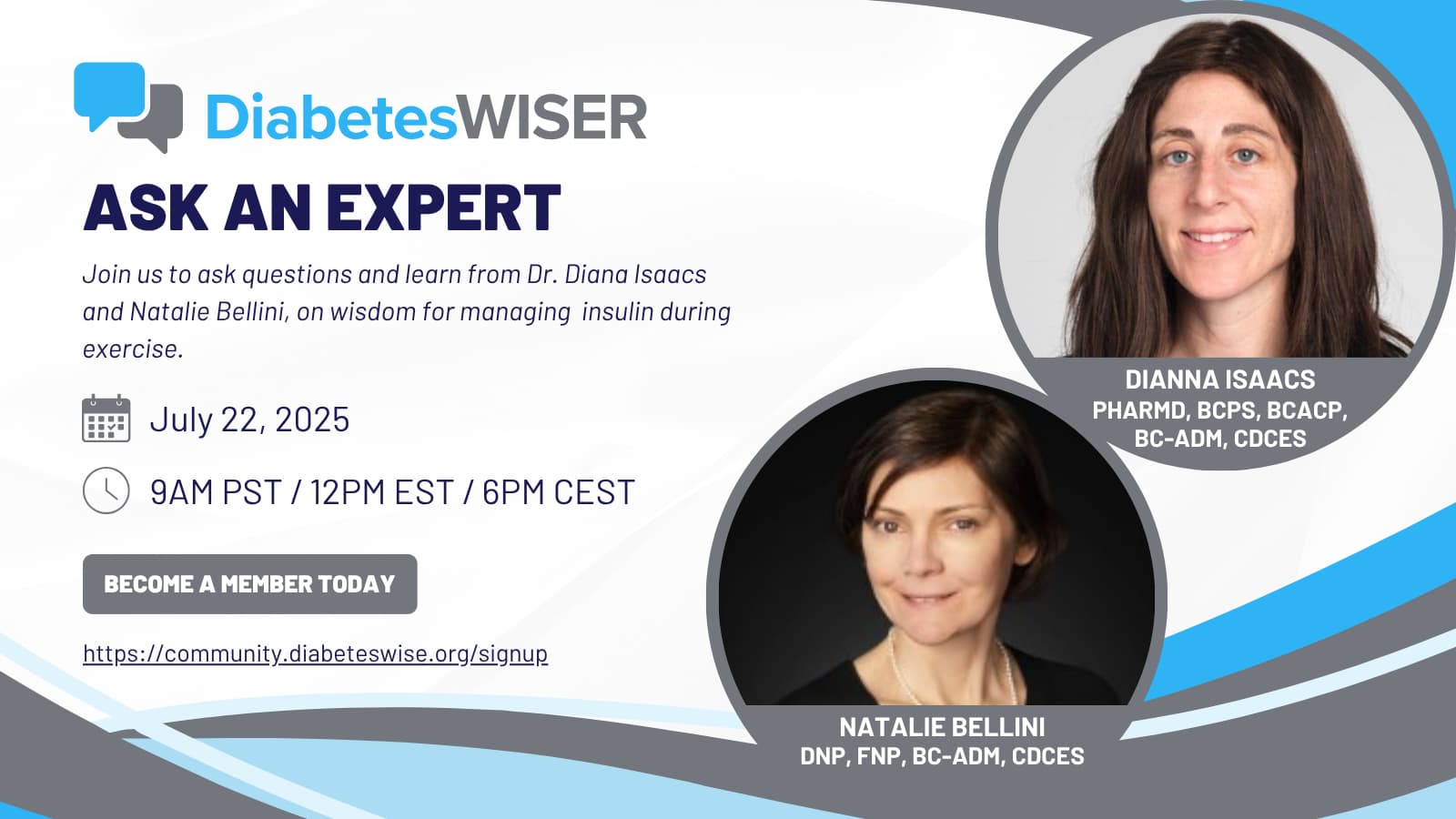
Looking for advice on insulin management during exercise? Join Dr. Diana Isaacs and Natalie Bellini! They will answer your questions! They are also available to discuss AID and smart pens during exercise, setting adjustments during workouts, types and compositions of foods to consider before/during/after exercise, as well as insurance coverage questions.
They will be answering questions live for 1-hour on July 22, 2024 at 9AM PT / 12PM ET / 6PM CEST. But feel free to ask questions ahead of time!
Greetings Dr. Isaacs & Dr. Bellini, I have some difficulty with exercising MORE than 25 minutes ( moderate to intense exercise) If I am able to do it…( BSG above 110 ) I tend to crash fairly hard and then I have to eat something ( which counteracts the entire focus) I have tried very small amounts of sugar ( e.g. a single lifesaver 3G) which can help but I have been unable to exercise more than 25 minutes most of the last 15 years.
I have learned through experience to not have any insulin-on-board while exercising, but recently I have gotten into running half and full marathons, and I had been struggling with high blood sugar during this event because I am taking these gels every 30 minutes or so that are quick sugar. I would delay my basal until after the race and have no basal on board for fear of going low, and my body couldn’t use the carbs as fuel because I had no insulin on board.
How should I run a 3 hr race while taking 22g of carb every 30 min(6 gels), on MDI?
Hello everyone. I am Diana Isaacs, PharmD, CDCES. I work as a clinical pharmacist and diabetes care and education specialist at Cleveland Clinic. I specialize in diabetes technology. I also have a podcast with Natalie Bellini called Diabetes Dialogue: Technology, Therapeutics and Real World Perspectives. It’s great to be here with all of you today to answer your questions about manging insulin with exercise.
Hi Diana and Natalie!
When thinking about exercise and managing or adjusting insulin doses, it can feel overwhelming to know where to start and what to adjust. Basal rates, bolus insulin, carb ratios, ISF, something else??? One day you might reduce your bolus a little and the next day reduce it a lot, but there is often so much variability day to day. Do you have any suggestions on where to get started? Do your patients reach out to you more often than their scheduled diabetes care visits?
Hi, that sounds so hard! If you can let us know if you’re using insulin injections vs. an insulin pump, we can offer some tips. With insulin injections, there are options to decrease insulin doses prior to exercise. With a pump, there are a lot of different options depending on the type of pump. I recommend finding a diabetes educator that you can work with to come up with some individualized strategies.
Hello my name is Natalie Bellini. I am an Assistant Professor of Medicine at Case Western nurse practitioner and Reserve University and the Program Director of Diabetes Technology at University Hospitals in Cleveland Ohio.
Hi Dr. Isaacs and Dr. Bellini! So excited to “see” you both here. Would love to hear your thoughts on supportive/protective activity with GLP-1 use. Have heard more re: strength training recently and curious what your thoughts are on “must do” activity with GLP-1. TIA!
In the DIY community there is a different approach to pumping and activity that i have used and seems effective. Using a Temp Basal pre exercise for the length to the activity time, Temp basal for a not before an hour activity. The temp basal is stopped during the activity to avoid highs from missing basal. Have you tried this and if so what has been the outcome?
Dessi, you are correct! There are a LOT of options when making adjustments to AID or MDI.
For AID with aerobic exercise we really like to start with whatever your pump calls activity feature/mode and as early before exercise as possible. I will admit that when we do more spontaneous exercise I simply turn on and eat 5-10 uncovered carbs. I also recommend leaving on the activity/exercise for a few hours post exercise if you find yourself dropping afterwards.
To answer the last part of the question first, if this is an area a person wants to focus on, then I have more frequent follow-ups, like every month to try a few different strategies and see what works. If someone has a severe low or is really struggling, then I encourage them to reach out in between as well.
I agree. If we can get some of the basal out, but not so much that you end up high is the real goal! I am looking forward to trying this on the new Twiist pump in the next few weeks.
Hi, great question about glp-1 which are being used more commonly in people with type 1 and type 2. There is concern about loss of muscle mass. By doing resistance training, you can keep up the muscle mass especially with aging. Also, it’s important to maintain good nutrition as some people find such a decrease in their appetite and get enough protein.
The impact of changing the basal rates due to the hight target creates all kinds of issues with CF, IC and timing post activity. The fix of going back to normal basal seem to be working quite well and helps avoid highs and lows post.
 Would love to hear your thoughts on supportive/protective activity with GLP-1 use. Have heard more re: strength training recently and curious what your thoughts are on “must do” activity with GLP-1. TIA!