It seems that the general experiences around airport security and diabetes devices are often similar for people with T1D - an added frustration!
I have seen many different recommendations around keeping pumps on or taking pumps off through the airport metal detector versus the airport body scanner. Articles online differ as well, so I’d love to hear what people do or if they have any resources they refer to around this topic
Remember that opinions and experiences can differ in this space and that’s ok! Looking forward to the discussion and learning what other do. Thanks!
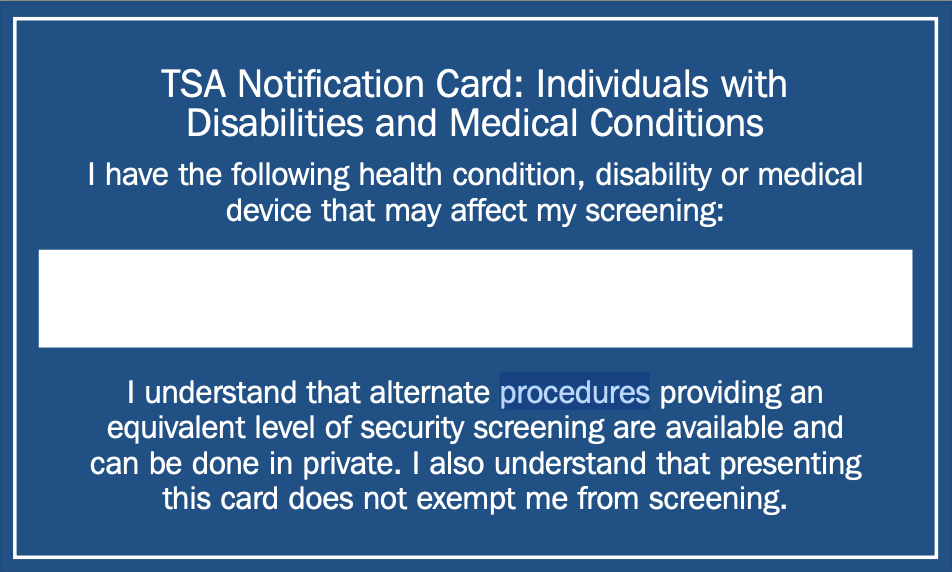
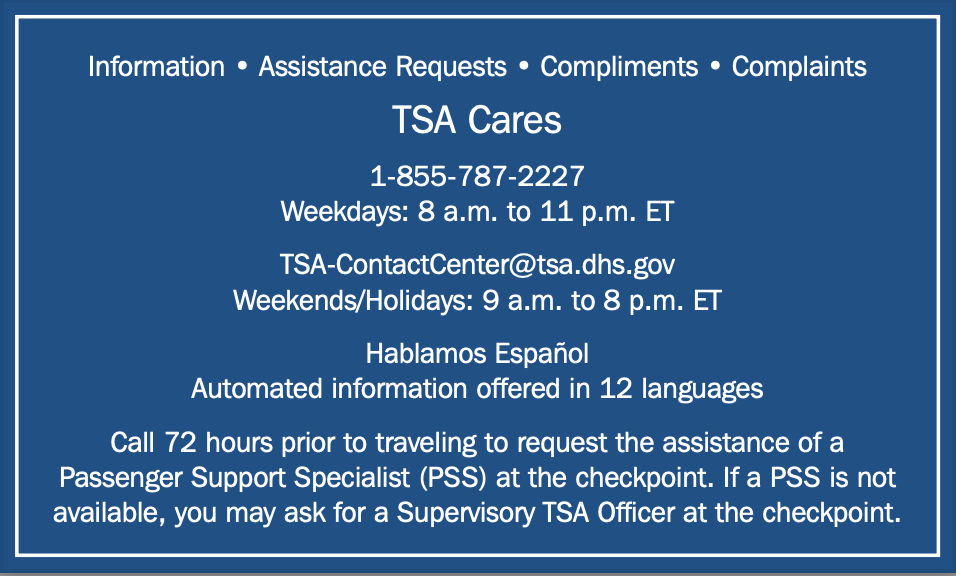
TSA offers a disability notification card (see below) that you should be able to show to let the TSA officer that you have a condition or a medical device that might affect your screening.
I agree, these cards are helpful to carry. I don’t know the specifics that TSA Cares covers, but I know others do! Chris Bright might have more to share because I know he’s done a lot of work in this space in the UK! I am always curious what is the actual guidance around keeping devices on or taking them off when going through airport metal detector or the airport body scanner? It feels like each airport is different, each pump and CGM system differs slightly, and everyone with diabetes has their own “protocol” they follow that works for them
I agree that it can be very frustrating to navigate airport security with an insulin pump and/or CGM. Especially when traveling through non-major airports with less exposure to diabetes devices.
For tubed insulin pumps, you can detach before going through security and request a “hand inspection” of the device. The pump is handed back to you as soon as you complete the baggage and body scan.
However, since insulin pods and CGMs are not easily detachable, it can get a bit tricky. In my experience, TSA requests a pat down of the CGM/pump site then sends you off. So far, I’ve kept my CGM on and my readings have been ok after.
As @AikaSU mentioned, you can request a private or public pat down. This usually takes up to 30 minutes and sometimes longer if you have a preference for a female or male agent to complete the pat down.
I’d love to hear how others handle airport security!
I always follow the manufacturer recommendations to ensure I remain under warranty with my devices. (Here’s Tandem’s, for example: Printable Note for Flying with Your Pump).
I’ve actually had much better luck at smaller airports with getting through security with a hand check. San Francisco is generally a nightmare, but part of that is because their TSA agents are private contractors and seem to play by their own rules.
I’m more worried about the manufacturers not replacing a pump if something goes wrong during traveling, so I typically give myself an extra 30 minutes at the airport in case I need to do a pat down.
In the past I’ve worn my pump through the metal detector and it alerted. That required a full body pat down. Now I remove the pump and pass it around the detector to the TSA agent and walk through. They hand it back and we do the swab to check for explosives residue (negative) and I’m on my way. It’s worked I. Large and small airports.
Unfortunately, each airport is different (certainly between countries) and the guidance is often not made public under the banner of security.
Generally speaking, the officers cannot request you remove a medical device and, while you can request an alternative method of screening e.g. a pat down, it is not a right. If they insist you go through the machine you have the choice of complying or not flying.
Being a middle-aged while male almost certainly helps but, in my experience, being polite, staying calm, requesting a pat-down because you have concerns about your device going through the scanners (even if they insist it is safe) generally gets the desired outcome. They may drag their heels a bit as a deterrent for doing it again but that has been the worst of it for me, and I generally thank them for their work.
Ultimately, their job is to keep everyone at the airport safe. If they see you respect that and are happy to work with them to achieve it, my naive position is you should be ok.
I’ve been travelling with insulin, pumps, syringes and just about every other device imaginable. I visit the airports a TON. I ALWAYS mention to an TSA officer about my pump/insulin/medication/etc. My previous pump I wore through backscatters and magnetometers both. I never had an issue. In my 84 recent visits ( since 2022) i’ve never had a problem bringing them through the magnetometers. The LAST visit I had a TSA agent ask me if I could stop my pump, disconnect it, and then go through the hand swabs stuff.
Thanks for sharing. Similar experience for me! I often let them know at TSA, but sometimes I have just kept all my devices connected and nothing goes off - those are always the better days !
Hey Dessi and all! We have a page on the Breakthrough T1D website in the UK which showcases a number of key areas on this:
The page includes the Medical Device Awareness Card, which looks similar to the TSA Disability notification card, to inform security around carrying a medical device/insulin pump. I’m also working on knowledge for Airport Security teams wherever possible. As a charity we now sit on a number of the Airport Accessibility Forums, to put across the needs of those with type 1 diabetes travelling through some of the UK’s airports. Combining this with some work we’re doing around awareness with one of Europe’s airlines, we hope to shift some of the challenges people face with the condition in this part of the world… It’ll take time and it’s a worldwide conversation and issue to resolve though! Different scanning technology across the globe poses communication challenges for what can and can’t go through, which quite often means a blanket, nothing can go through from device companies… It makes sense as to why that occurs, but we have to work with the airports to make sure they understand what people with Type 1 Diabetes are entitled to and why that’s the case. Trying to filter as much information out there as we can!
Great question airport security can definitely be tricky with diabetes gear! I usually keep my pump and CGM on and request a manual pat down instead of going through the full body scanner. It’s slower, but safer for the devices. Dexcom and pump manufacturers usually recommend avoiding x-ray and full body scanners, so it’s worth checking their official travel guidance before your next flight.